One of Ernest Hemingway's most famous pieces of writerly advice was to write what you know. The truth however, is the opposite.

Showing posts with label Hemingway. Show all posts
Showing posts with label Hemingway. Show all posts
Sunday, October 17, 2021


Monday, November 25, 2019
A Case of the Mondays
 |
| Photo courtesy Quartz |
Anyone who’s
ever watched the 1999 movie, Office Space, knows just how dreadful and soul
sucking a day job can be. Being ball-and-chained to a small cubicle for eight
and half hours per day is, to many people, a form of slavery. But hey, unless
you’re independently wealthy, everyone’s got to work. We have to eat, right? We
have bills to pay.
Too bad most
Americans are said to be only $400 away from being flat broke, meaning, they
not only live paycheck to paycheck, they can’t afford it when their car breaks
down or the refrigerator goes on the fritz. If that’s not depressing enough,
you’re still expected to show up for work on Monday morning.
A Case of the Mondays
In Office
Space, the main character Peter, played by actor Ron Livingston, is so
depressed after having arrived at his dull, soul sucking job on a Monday
morning, he decides to skip out for a coffee along with a couple coworkers.
They visit a nearby cheesy chain establishment, Chotchkies, which is sort of
like TGIF Fridays on steroids. Like Fridays, the staff is not only expected to
where an obnoxious uniform covered in “flair,” their attitude must be over-the-top
happy.
The server
Peter and his buddies get is just one such individual. As they sit down, the
server, Brian, played by actor, Todd Duffey, plants a broad, if not obnoxious
smile on his face. It’s a direct contrast to the gloomy, upside down faces
seated around the table.
“Looks like
somebody’s got a case of the Mondays,” Happy Server Brian says.
I’m not
going to give away too much of the movie’s plot, but suffice to say, from that
point on, Peter is determined to find a way not only to get rid of his job, which
is presided over by his evil boss, William Lumbergh (Gary Cole), he wants to
find a means of employment that will allow him to do nothing at all, every day,
all day.
Maybe Peter
didn’t realize at the time, but what he's talking about is passive income.
Writing as Passive Income
One of the
main reasons I got into freelance writing and fiction writing in the first
place was to avoid a day job. I was groomed to run an industrial and commercial
construction company. Immediately after college, I was given a week off and
told to report to the office. There was no backpacking in Europe with my
friends, no heading to New York City to land a job perhaps as a cub reporter,
no heading cross country to find my fortune on my own terms…no fun of any kind.
I was to
report to the office and begin my apprenticeship as a junior executive. Here’s
how the first year went: I hated every minute of it. Now this is not to come
down on what many people would consider the opportunity of a lifetime, and it
was. But the problem was, I knew in my bones the career wasn’t for me. I couldn’t
stand being cooped up in an office all day checking packing slips and asking
for quotes on windows and doors. It wasn’t my cup of tea.
Emotionally
speaking, here’s how a typical week would go. Monday morning is a horrible
experience exacerbated by lack of sleep, anxiety over what the day will bring,
and the empty feeling of utter hopelessness since at that moment in time, another
Friday seems like an impossible dream.
By Tuesday
you loosen up a little and resign yourself to the job. By Wednesday you see the
light at the end of the tunnel. Thursday you’re starting to feel like you’re gonna
make it after all. Friday you’re exuberant. Friday night you get drunk with the
friends, and you do so again on Saturday. By Sunday the hangover kicks in and
by Sunday night you’re miserable once again because guess what day dawns in the
morning?
Rediscovering Hemingway
In my spare
time, I read all the books I couldn’t read or didn’t have the time to read
during my undergraduate years. I was especially fond of the Hemingway novels
and short stories. I also got heavily into the Hemingway biographies,
especially the Carlos Baker biography which, at the time, was considered the
quintessential work on the adventurous author.
I loved it.
I
wasn’t halfway through with the big book when I realized, this is the life for
me. Hemingway didn’t just write, he lived the life he was writing about. He
lived in Paris, went to the bullfights in Spain, hunted lions in Africa, fished
on the Gulf Stream, married a very rich lady, built a house in Key West, and
what’s more, he never had a real job other than a few short years as a full-time
newspaperman.
The
Hemingway life was the life I wanted to experience. When the realization sank
in, it was like a big bright light had gone off inside my brain and my heart. I
felt lighter than air because I had found my true calling. It must have been
what a priest experiences when he finally discovers his sacred mission in life.
I didn’t
waste any time. That day I announced to all my friends that I was giving up the
construction business to be a writer.
They all
laughed at me.
Proving the Naysayers Wrong
Proving the
naysayers wrong would not only take determination, it would take guts and a
willingness to start at the bottom. After all, back then, I had more enthusiasm
than talent. I started writing on the side. Taking a cue from the great
Hemingway, I got a job at the local Times Union Newspaper writing sports
stories on the weekends. I also started freelancing for them. Stories ranging
from fly fishing for trout and bass, to travel pieces, to book reviews.
Again, like
Hemingway, I tried my hand at writing some short stories. Before long I found
myself getting published in journals like the Maryland Review, Fugue, Old
Hickory Review, Buffalo Spree, Orange County Magazine and many more. My
journalism was getting published in New York Newsday and Hudson Valley
Magazine, and I would be accepted into the prestigious Bread Loaf Writers
Conference in Vermont. I was working hard, but I was also making a little money
and, more importantly, making my way as a literary neophyte.
That’s when
I applied to Vermont College for my MFA in Writing. I was accepted. Suddenly,
my friends were no longer laughing at me.
Back to a Case of the Mondays
There was no
stopping me. I plowed through writing school like a man possessed and in the
process sold a novel that would fetch a very major deal. And while that deal
would have its issues, I would never again work a real job. That was over
twenty years ago. The writing life has had plenty of ups and downs since then, but
I can still wake up on Monday mornings, and if I so choose, roll over and go
back to sleep. What’s more, I can do this in Italy if I want, as easily as I
can do it here in New York. Books sales, for the most part, are a passive
income monster. You sell books while you’re sleeping or, like Peter from Office
Space aspires to, while you’re doing absolutely nothing at all.
Come to
think of it, I’ve worked really hard for the right to do nothing.
Thursday, November 21, 2019
Hemingway's New Novel

The title is not a typo. Nor is it click bait. Hemingway does indeed have a brand new novel presently making waves in the literary marketplace. One clarification however. The author is not Ernest, but instead, his grandson, John.
I've been following John's career since the publication of his family memoir, Strange Tribe back in 2007. I recall receiving the book as an Xmas gift and reading it in one sitting. Beautifully written, it contained stunning information that had never before been revealed about his father Gregory who later become known as Gloria, her trans-sexual moniker.
On the surface, young Greg appeared every bit the Hemingway hero. He was a brilliant shot, having won many major shooting awards against adults many times his age. He loved baseball and later became a professional white hunter in Africa. But as a boy, he had an unusual desire to wear women's undergarments. Indeed, he stole Ernest's fourth wife Mary's underclothes at one point, and the rather taken aback Papa had no choice but to confront his son about it. You might assume the master of the macho would have blown his top. Instead, he more or less showed empathy for his youngest boy, even going so far as to say, "We're a strange tribe, Gig" (Gig, was Gregory's nickname, along with Mouse).
This makes perfect sense when you read some of Hemingway, the senior's work, such as the posthumously published, The Garden of Eden, in which Papa explores the boundaries and possibilities of androgyny, something he would make manifest in the novel's main characters who cut and color their hair, bright white. They also dress very much alike. Now you are me and I am you, is Papa's fetishistic theme, and it is an entirely fascinating one.
 |
| John Hemingway |
But this isn't about Greg or Ernest. It's about John, who is not only full-time writer, he is also a avid traveler who has a gift for languages. It's not unusual for his emails and texts to contain three different languages, two-thirds of them I pretend to understand, despite the months I spend in Europe every year. He is also a witness to literary history having fished with Norman Mailer and lived with Ernest's brother Leicester in Miami for a time.
His latest book, Baccanalia: A Pamplona Story is one Papa himself might have approved of since its setting is Pamplona, Spain, where the Running of the Bulls occurs every July during the Festival (or fiesta) of San Fermin--an event the senior Hemingway made famous in his first novel, The Sun Also Rises.
Is Bacchanalia the sequel to The Sun Also Rises? Methinks some critics will look at it that way. It is a book with a wild cast of characters, just like Sun, but according to John, the main character is the fiesta itself, all its energy, drama, violence, revelry, inebriation, and celebration brilliantly coming to life on the written page. But it is a new book for a new century also, and one that mirrors the life and times we currently live in.
John bears the unique responsibility of carrying on the Hemingway legacy, and like his grandfather, he has become a citizen of the world. He is as much at home in Pamplona as he is Havana and Key West, and looking at him, you definitely see the resemblance to Papa. Same eyes, same smile, same scruff. Sometimes the resemblance is frightening.
John who make his home just up north in Montreal along with his wife and a very big dog, was gracious enough to accept my invitation to write a guest post for the Vox regarding his new novel. It's an essay that explains the architecture of Bacchanalia that you might find as fascinating as the book itself. As I was reading both, I thought, perhaps John will write the sequel to Ernest's famous nonfiction book on the art of the bullfight, Death in the Afternoon. If anyone can do it, it would be John. He is, after all, uniquely qualified. Imagine the press that would attract? I hope John takes on such a project. In any case, isn't it pretty to think so.
I give you John Hemingway:
Bacchanalia, A
Pamplona Story is a novel that takes place during the Fiesta de San Fermin.
It follows the activities of a group of expatriates as they live the nine day
festival to its fullest, running with the bulls in the morning, watching the
bullfights in the afternoon and in between drinking, partying, feasting,
flirting and making love like there was no tomorrow.
The characters are of different nationalities and
backgrounds and each of them finds something unique in Pamplona.
Frank is an Italian-American poet/house painter from Los
Angeles, who keeps returning to the Fiesta year after year because the Fiesta
first seduced him and then saved him from himself.
Hector is Frank’s best friend. He is a Mexican-American
novelist from San Diego and an ex-Golden Gloves boxing contender who never went
pro on account of his bipolar condition. He runs with the Spanish fighting
bulls every morning because he is a Shaman (or a man of knowledge) and the
bulls are for him a source of spiritual strength and enlightenment.
Peter, another friend of Frank’s, couldn’t be more different
from Hector. He is an ex-Navy Seal who was wounded in Afghanistan and who has
discovered that running with the bulls helps him control his post-traumatic
stress disorder.
Clive is an upper class Englishman who flew with the Royal
Air Force as a fighter pilot before he gave it up and moved to Spain to become
a bullfighter.
Ian is a hipster Scotsman with long blond hair and a braided
beard who sells derivatives in the City of London. He has a very un-politically
correct, ribald sense of humor, which he uses as a way of breaking the ice with
anyone he encounters.
All of these men in turn are attracted to Irina, a young,
stunningly beautiful, twenty-something, Russian temptress from St. Petersburg. She
is visiting Pamplona and its Fiesta for the first time and everyone wants to
have her. Everyone wants to be her boyfriend, to take her to bed or just to buy
her a drink, but she is the one who decides, not the men.
But perhaps the most important character in the novel is the
Fiesta itself with its traditions and mysteries, its vitality and tragedy, its
joy and almost bipolar duality between the spiritual and the pagan. It is an
event that is forever changing and continually renewed by the millions of
visitors who have embraced it and will continue to embrace it in the years to
come. It is the Bacchanalia, one of the few places left in the modern world
where a man can take a chance and risk everything for love or a fleeting run
with the bulls.
Grab your copy of Bacchanalia: A Pamplona Story HERE.
WWW.VINCENTZANDRI.COM
Last chance to preorder THE EXTORTIONIST before it's November 29 release...

Saturday, January 19, 2019
The Toxic Male Need Not Be So Toxic
 |
| Norman working on Tough Guys Don't Dance |
I'm not entirely sure where the term toxic male came from, but for sure it's a 21st century phenom. Used to be that a man who was proud of being a man was referred to as a rugged individualist. You know, like the Marlboro Man.
Hemingway fit into this category. Later on, during the turbulent 1960s, Norman Mailer, who was a Hemingway fan (he actually sent Papa a copy of his novel The Naked and the Dead, but Hemingway never responded), would espouse the fact that men and women are indeed, physiologically, emotionally, and biologically different.
He'd enter into heated debates with the likes of Gloria Steinem, while likening women's equality to that of the Civil Rights movement a la Dr. King (Not LBJ who's Great Society was a way to keep minorities on Welfare and therefore voting blue). In other words, if you wish to rise up and improve your lot in life, then by all means, do it as an individual. Prove yourself and your worth. Don't depend on any one politician or the government to do it on your behalf. No one deserves to be POTUS just because of their sex, for instance.
Bi's and Tri's day...toxic masculinity or just plain living strong...
It's a dangerous time for men. Men are accused of sexual impropriety and all too often it's the accusation that counts, not the proof or lack thereof. Men who are considered macho or ummm "toxic" are seen as a relic of an unhinged past. Men should be more feminine and less traditionally male in attitude and approach. Boys are being taught and raised this way in our schools. In a word, men should apologize for being, well, male. This is not to say there aren't some serious creepers out there who deserve their time in the gulag for what they've done. Bill Cosby, Harvey Weinstein, and Uma's ex-husband, Anthony Weiner come to mind. There are others of course.
But much like the women of this country are collectivizing for their right to do what they want with their bodies, their unborn babies, and their lives, men should not lose sight of the fact that it's okay to be a man. A strong man. I believe that deep down inside, women love strong men by their side rather than wimps. My gym, Planet Fitness, recently removed all the free weight benches from their facilities because they wish not to promote bulky, strong, men. This is, of course, as much fanatical bullshit as their refusal to broadcast FOX News on their many wall-hung televisions, choosing instead to play only the mainstream left leaning stations...CNN, MSNBC, PBS among them (the airports do this too). But then, it's their gym, they can do whatever the hell they want.
That's why I now work out mostly in my own home gym. I like pumping iron. It's not only awesome for the heart, the muscles, and the bones (especially for a middle-aged man who ain't getting any younger), but lifting free weights makes me feel strong and when I feel strong I feel like I can defend myself better, and defend anyone who I might be with at the time. As many of you already know, I was sucker punched by a total coward in a bar in Italy recently, and I swear, if not for my weight lifting regimen, I might have been seriously injured. This guy snuck up behind me, gave it everything he had, and I still walked away and enjoyed a couple drinks after. How's about them apples, coward?
Hemingway also loved to box, and on occasion he would lift weights. Mailer too loved to box and hit the weights when he could. These physical activities didn't make them toxic males, but it did make them quintessentially male. This maleness was reflected in their prose which dramatized characters who said what they meant, and meant what they said and who were willing to back it all up with their fists, if need be, even if it meant they got their ass kicked in the process. It made them rugged and it made them proud. Listen guys, there's nothing wrong with being a man's man, just like there's nothing wrong with respecting a woman and everything she stands for. We can coexist with who we are as a species, who we are as men and women, and as individuals.
As much as things are changing, and as much as the mainstream media gives one the impression that all the old chivalrous traditions are goin' bye bye, well, let me tell you something, over the course of the past year or so I've been on at least a dozen dates, and in almost every case, I paid the bill. Gladly paid the bill, I should say. I also held open the Jeep door for my dates. Because that's the way it should be. I was acting like a man, a proud strong man, and there was nothing toxic about it.
WWW.VINCENTZANDRI.COM
Tuesday, December 4, 2018
One True Sentence
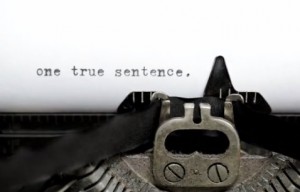
When it came to writer's block, or the prevention thereof, Hemingway once coined the famous dictum, "All you have to do is write one true sentence. Write the truest sentence that you know." Ever since then, scholars have been scratching their heads as to his precise meaning and Papa is no doubt still laughing his balls off even from the grave.
What the hell does that mean? Write one true sentence.
Okay, I get it. You gotta get the sights, sounds, smells, tastes, and emotions spot on. Like a reporter would do for a newspaper story (Hemingway started out as a newspaper reporter). He would strive for accuracy in setting and action. But Papa was writing fiction which by definition is a big fat lie masquerading as the truth. Even if you're writing dystopian sci fi, you're going for as believable a book as possible.
But by writing that first true sentence, which in my case is usually a false sentence that should somehow read as something that, theoretically anyway, could have happened (or be happening in the case of the first person POV), I'm creating a kind of truth that would otherwise not have existed. Get my meaning here? I'm creating a whole new world, new characters with real drama, real problems that are at times life threatening. I write thrillers after all.
I just spent the past six weeks writing 70K words for a new book that takes place ten years in the future called Primary Termination. It's about a consumer-centric online company that essentially controls every aspect of your life and the Resistance movement that rebels against it. How did I begin a novel that takes place in a year that hasn't occurred yet, based around a plot that can only be imagined?
I wrote one true sentence.
"She's drowning in her own air." It's the first sentence of the prologue and it's the truth because my protagonist is running for her life. Then I wrote what would happen next and what would happen after that and so on and so forth. All of it is true and all of it is a lie at the same time. A fabrication based on a perceived truth. A sculpture, a painting, a sketch, a video game, a film, a song, an illusion, a book...it's all true and it's all made up.
One true sentence. It's what I have in the place of writer's block.
Thanks Papa.
WWW.VINCENTZANDRI.COM
Get the brand new Sam Savage Sky Marshal Thriller, Tunnel Rats!

Subscribe to:
Posts (Atom)