
Showing posts with label independent publishing. Show all posts

Saturday, February 25, 2017

Coming Up for Air: Notes from a Hybrid Author (Part ???)


I think it was late August of 2016 when I was informed that my services would no longer be required at the one trade journalism gig I maintained outside of my fiction career. It was a sweet gig that ran for ten years, an absolute lifetime in the fickle world of freelance journalism. I wrote architecture and construction related pieces, and it paid well and I won a bunch of awards along the way.

But after the new owners came in and cleaned house, I searched for another similar job, but my heart wasn't in it, so I abandoned the search almost as soon as it began. Which lead me to the realization that I should be putting that extra time towards creating more fiction in the form of serial novels, stand-alone novels, short stories, and novellas. Material that would provide passive income for years and years, as opposed to journalism in which you get paid for your time.

That said, since September '16, I've written and completed two novels. The Ashes and the forthcoming The Embalmer, the pilot novel in what will be the new Steve Jobz PI series. I've written the pilot episode in a new CIA-inspired series called Assignment Rendition, and completed two new Chase Baker pulp thrillers, Chase Baker and the Dutch Diamonds and Chase Baker and the Spear of Destiny. At present, I'm closing in on the half-way point with another stand-alone thriller, The Girl Who Wasn't There.

Also completed are several short stories, including Moonlight Gets Served which appeared in Pulp Metal Magazine and Dressed to Kill (A Jack "Keeper" Marconi PI Short Shot), among them. The latter was also serialized in Pulp Metal and will be published in its entirety under my own label, Bear Pulp next week sometime. Add in maybe half a dozen essays for the Vox, and several guest posts and pieces, and it's been one hell of a busy six months.

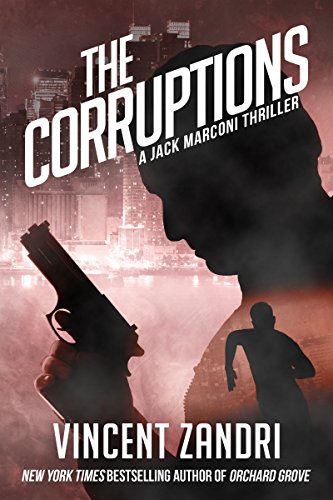
In the midst of all the new work, I also managed to rewrite The Corruptions several times in preparation for its late January '17 publication (Polis Books), along with a new stand alone, The Detonator, which will appear in January '18 in hardcover (also Polis Books). Amazing when you stop to think that I consider this part-time work.
So, with all this material needing homes, kind of like lost, wayward orphans, I will have to make the decision on who will publish what and when. In the old days, you wrote maybe one book per year, and hoped your publisher would push the crap out of it (which they usually don't). But now you have options. You can maintain your own list of titles of which you control the writing and the marketing.

But I'm a strong believer in having your books in the bookstores as well, and that's where the traditional market comes in. I enjoy seeing my novels come out in hardcover and reviewed by the major trade journals and papers. It gives me professional satisfaction and the respect of my peers. But there's nothing like having total control over your books as well, and that's where the beauty of indie publishing becomes self-evident.

I guess some authors choose to go hybrid because they feel it's smart to take advantage of all the publishing options out there in this, the new golden age of genre fiction writing. I do it because I really have no choice. Just make a quick count of all those books and stories I mentioned above. No way a publisher is going to take on all that work. They wouldn't be able to keep up, nor would they want to. I'm curious to see how the next six months goes, and how many more stories and novels I can produce. At 2,000 words per day (good words), I suspect it will be quite a few.

WWW.VINCENTZANDRI.COM


Sunday, December 4, 2016

A Big Backlist is Really Your Frontlist


Over the course of my twenty year career in  professional publishing, if there's one thing I've learned, it's never what you've done or accomplished, it's always what you're about to do that's important. Publishers big and small, are always looking for the next big thing, the next big book, the next bigger than God author who is going to break out and amass great wealth for publisher's bank accounts.

And every year there is usually one writer who fits this bill. Almost always, the publisher creates the myth of the next big thing by tossing a huge advance at the poor soul (he doesn't realize he's a poor soul yet because he will of course be broke and needs the money badly), and the press will greedily snatch up news of the sale, the rationale being, if the book is worth so much money, it's got to be great!

Problem is, most writers don't earn out their advances, even humble ones. I was one of those mega six figure advance debut authors once upon a time and it nearly cost me my career in the short run when the six month bottom line turned out to be redder than Rudolf's nose. That's right, not six years, but six months. But for publishers, the point is not necessarily an author earning out a big advance right away as it is creating a buzz over something new. A book that is so fresh and unique it somehow deserves our utmost attention. Attention should, theoretically speaking, translate into sales.

But what about an author's backlist?

According to a new essay by marketing genius Seth Godin, the aptly misnamed backlist is really the true money maker for both author and publisher. These are the books that sell perpetually for both author and publisher year after year after year. Yet, according to Godin, publishers only invest about 2% of their annual marketing budgets to any given author's backlist and the rest goes to someone or something that's new, and never been done before. Thus the old conundrum, it's never what you've done, but what you're going to do.

Another thing I've learned about publishing is that publishers, and especially their marketing departments, tend to think short term. If they don't think a book will sell well out of the gate, no matter its merits, it's rejected. These days a book has to conform to the algorithms established by the computer software or it's "Thanks but no thanks." Problem with this philosophy is that some books take time to sell.

That debut novel for which I received the mega advance, The Innocent? It didn't take off until a decade later when, for some inexplicable reason, it sold more than 100K copies in a matter of a couple of months. By then another publisher had bought it, and then yet a third publisher snatched it up along with the offer of a rather generous advance.

But how can that be? 

The Innocent, as a viable book project was done, over, roadkill, six-feet-under, washed up, "You had your chance, kid, now beat it." You get the picture. Yet the book defied publisher (and marketing department) logic and suddenly took off. There was no rhyme or reason to it.

Eventually all my books become backlist books.

It only takes a few months these days for a book to be considered old. A fruit fly has a longer life than a new novel, no matter what the advance. Bookstores, the ones that are left standing, only have so much space. But thanks to ebooks, backlist books can now be promoted right up front with an author's new releases (this means backlist books produced in paper and audio as well).

A few independent minded publishers see the value of actively promoting backlist books. Amazon imprints are one of these. Thomas & Mercer continually promotes The Remains even though it was released in late 2012. It sells tens of thousands of copies per year, and during one year in particular, hundreds of thousands. Because of that, I just published The Ashes, the novel's sequel and next year I'll publish the third book in what's become The Rebecca Underhill trilogy. I'm not looking forward to the followup books to The Remains being frontlist hits (although that would be nice), but what I'm aiming at are those existing fans and future fans of The Remains who will be wanting more of the story. Those are the readers who will gravitate to the next two books in the trilogy.

It dawned on me recently...wait, scratch that...allow me to rephrase. The realization hit me over the head like a sledge hammer the other day while I was banging out a news story, that as a freelance writer and journalist, we only get paid for our time and once the story is published it's already old news. In other words, like that brand spanking new car you just shelled out thousands for, once you drive it off the lot, it's immediately lost both its original luster and it's top worth. And even that freelance payment has become so reduced thanks to free media outlets (like this one), that it's becoming harder and harder to justify the freelance writer occupation. It just doesn't freakin' pay anymore.

But by publishing more and more novels, novellas, and stories...by creating a backlist that's masked as your frontlist...you can create the gift that keeps on giving. Some books will appear to sell poorly out of the gate but that given time will grow into steady sellers. Some books will kill it out of the gate and then die a slow death. That is, until you repackage it and republish it, thereby breathing new life into it. And other books will sell respectably well out of the gate and sell steadily for the rest of your days, your children's days and their children's days and so on and so forth.

As a hybrid author, I can state with confidence that the writing business has finally become an occupation that's not necessarily concerned with what I'm going to do, but a hell of a lot more focused on what I've already accomplished. For me, the past is indeed prologue. 

WWW.VINCENTZANDRI.COM 

Buy THE ASHES